
Columbus Previous Residents by Era
The record trail for previous residents changes with the period. Modern parcels and deeds can lead backward, but older Columbus addresses often need a lot, block, town, or legal-description search before a household source makes sense. The matrix below keeps each source in its own era and states what it can actually add to an address history.
| Source | Years it covers | Holding or route | What it can show |
|---|---|---|---|
| Columbus RG302 town-company records and lot deeds | 1856-1865 | Nebraska State Historical Society finding aid | Founding-period lot transfers and ownership context |
| Platte County Board and County Court groups | 1857-1934 | RG267 county records | County governance, probate, court, and property context |
| Platte marriages | 1858-1889 | FamilySearch catalog film and digital film | Relationship and date clues for early households |
| Federal census microfilm | 1860-1930 | Columbus Library Heritage Room | Household composition and enumeration geography |
| Platte County record groups | 1865-1985 | RG267 | Assessor, register, clerk, court, election, and treasurer series |
| Era, Democrat, and Telegram newspapers | 1874-2001+ | Heritage Room microfilm and CD holdings | Notices, obituaries, announcements, and address clues |
| Columbus Sanborn maps | December 1914 | Library of Congress | Structures, uses, streets, lot and block context |
| Columbus city-directory shelf | 1915-present shelf | Heritage Room | Citizen, business, telephone, and address snapshots |
| Columbus white pages | January 1940 | Nebraska Access | Telephone subscriber and address clues |
| Platte online deeds | February 1, 2005-present | Register of Deeds index | Modern grantor, grantee, and legal-description trail |
| Assessor, GWorks, and GIS links | Present | Platte County assessor | Current parcel, situs, owner, value, and map context where available |
Use the modern property route first when the address is current. Use a historical source first when the question predates modern parcel language. No row is a complete list of previous residents: deeds are conveyances, directories are dated listings, and the 1940 white pages exclude people without a telephone.
Start Columbus Previous Resident Research
Collect the current parcel ID, situs address, and legal description through the Platte County assessor and GIS route. The county links a GWorks property search, though its live interface and search fields were blocked during research. If the online link does not answer the question, call the assessor at 402-563-4902 or ask for an existing parcel card. Keep the owner's mailing address in a separate note from the situs address. The two may differ.
The legal description carries the address history across changes in street spelling or numbering. It may use a town or subdivision, block, lot, outlot, or Section-Township-Range. Preserve each version as written before normalizing an address for the next source. A current parcel value or owner label supplies context for the deed search; it does not establish when someone moved in or out.
Note: The current parcel is a starting reference for previous residents, not a shortcut that merges ownership, mailing, and occupancy into one fact.
Trace Columbus Previous Resident Deeds
The Platte County Register of Deeds is at 2610 14th Street, Columbus, NE 68601, and can be reached at 402-563-4911. The office keeps deeds and plats and can provide hard copies or scans. Its online index accepts grantor and grantee text, partial characters, and legal-description options such as town, subdivision, block, lot, outlot, section, township, range, and quarter selections.
The Platte County grantor-grantee deed index is the official online search route.
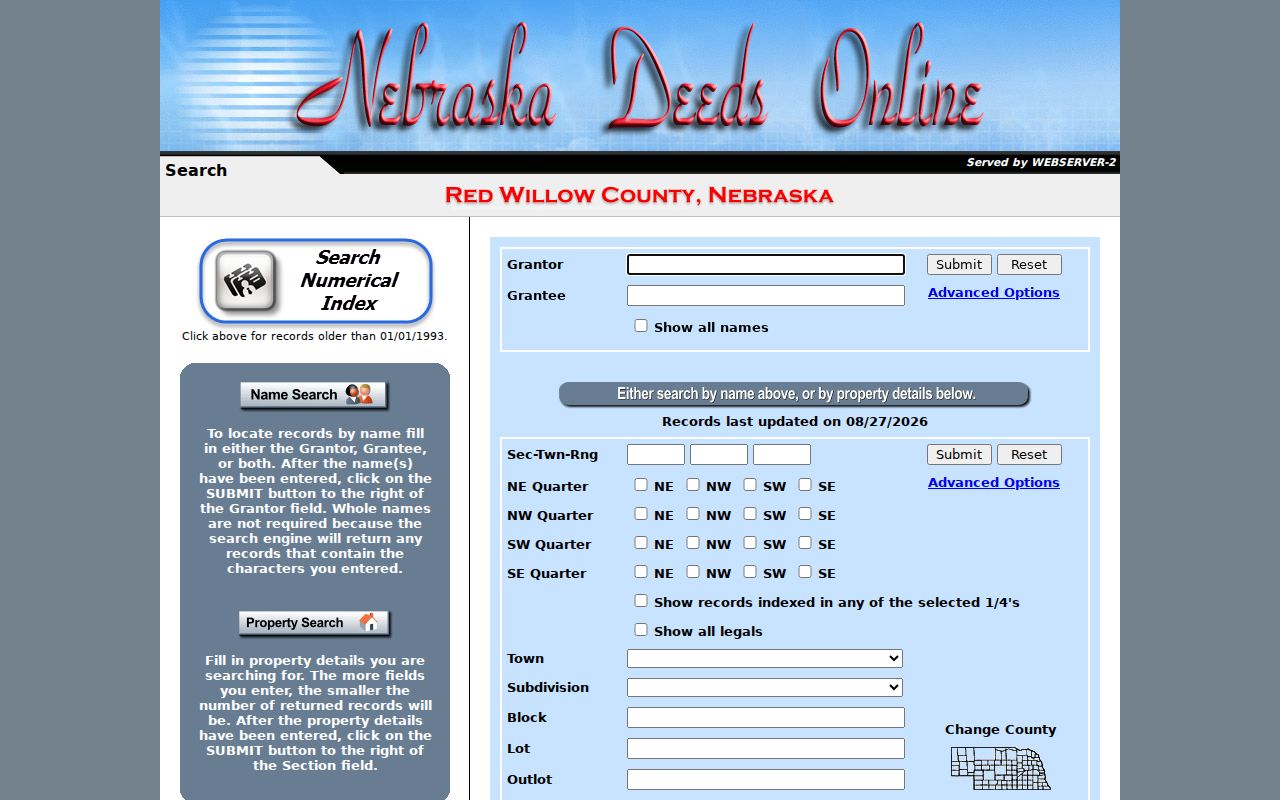
County guidance says data and documents from February 1, 2005 to the present can be viewed or printed free. The online image or any result fields should still be checked for the particular record, rather than assumed from the search form.
- Record the current legal description, parcel ID, and owner-of-record label without treating the mailing address as the situs address.
- Search the legal description, town or subdivision, block, lot, outlot, or Section-Township-Range in the recorder index.
- Find the current grantee as a grantor to locate that owner's conveyance out, then identify the earlier grantee.
- Repeat the grantee-to-grantor chain, logging document number, recording date, document type, legal description, and image availability.
- Follow a trust, estate, corporation, spouse, or multiple-owner transfer through each indexed name. The portal's Show all names option can matter.
- Grantor and grantee
- The grantor transfers an interest. The grantee receives that interest in the recorded instrument.
- Chain of title
- The sequence of recorded transfers connected by the same property description.
- Legal description
- The plat, lot, block, subdivision, or survey wording that identifies land more reliably than a changing street address.
Columbus Previous Residents Before 2005
Do not read the online start date as the beginning of Platte County records. The portal includes an archived-records link and refers to records older than January 1, 1993, but that reference does not confirm that every older image is digitized. For an earlier link in a chain, use the Register of Deeds counter, a written request, county deed books or microfilm, and the Nebraska State Historical Society's Platte County RG267 finding aid.
RG267 spans 1865-1985 and groups records by their originating office. It is a routing tool, not a single name index. County Court and Board groups, register records, assessor materials, and clerk records may point to an address or person, but item-level coverage varies. Ask for an existing series and date range rather than a broad search for all former occupants.
Columbus Previous Residents on Sanborn
The December 1914 Columbus Sanborn set has 11 sheets. The digitized Library of Congress map can show street names, block and lot context, building footprints, structure labels, and uses. It is useful for checking whether a structure or address setting existed before a directory or deed date.
Sanborn maps do not index people. Pair the mapped lot with a deed description, a directory listing, or a census record. A map confirmation means the physical context was mapped at that date; it does not prove that a named person lived in the structure.
Note: The eleven-sheet Sanborn set adds a physical snapshot to an address trail, not a resident name index.
Columbus Previous Residents Households
Ownership is only one part of a previous residents trail. The Columbus Library Heritage Room on the second floor has city directories back to 1915, census microfilm from 1860 through 1930, newspapers, cemetery books, marriage books, plats, and town maps. Books and microfilm remain in the building, and photocopies are permitted. The Columbus city directory page explains the holdings and how to read their entries; here, use the editions as dated household observations, not complete occupant lists.
Address flow: legal description to deed chain, deed date to first and last directory appearance, directory year to the nearest census period, then map or permit evidence for building context. The January 1940 white pages are another observation, but not every resident had a phone and OCR can misread names. A deed date is a recorded transfer, not a move-in date.
Newspaper titles also matter. The Columbus Era and Columbus Democrat began in 1874, then the Columbus Telegram title began in 1892. The Heritage Room holds microfilm through June 2001 and CD material after that. Search notices and obituaries with a date range and address clue, then keep an obituary, burial, estate, and former residence as separate relationship labels.
Columbus Previous Residents Founding Lots
Before modern parcel indexing, the Columbus Town Company created another layer of property evidence. The Nebraska State Historical Society's RG302 finding aid lists Town Company minutes from 1856-1885, lots deeded from 1857-1865, and stock transfers from 1856-1862. Those records are held as five items on one microfilm reel.
For a very early Columbus address, use the lot and owner context from that record group to bridge toward later plats and recorder descriptions. It is a founding-period ownership story, not a complete household roster. The person who acquired a lot may not be the person later listed at the address.
Check Columbus Previous Resident Addresses
Research did not verify a Columbus street-renumbering date, an annexation-by-address table, or a complete historic cross-reference. Do not invent one. Compare the street spelling, street number, legal description, plat, map, and directory wording before deciding that two forms describe the same location. Older white pages use forms such as 10 St, 14 St, 26 Ave, intersections, and rural routes that may not fit a modern search field.
Columbus city maps provide current limits, wards, zoning, and related map context. Compare them with historic plat and Sanborn material when a location sits near a changing boundary. A Columbus postal or directory entry can require a different county or municipal route from a present city parcel.
Note: Preserve the historic spelling in research notes and record any normalized version separately, so a later search can be repeated.
Columbus Previous Residents Boundaries
House-history research is strongest when it seeks the smallest necessary fact: who owned a lot at a recorded time, who appeared in a dated directory, or whether a structure was mapped. It does not authorize contact, surveillance, or publication of sensitive information about living people. Records may also omit people, contain OCR errors, or have sealed and confidential parts.
Lawful use. Use previous residents research for family history, estate questions, and personal address history. Nebraska's harassment statute bars knowing, willful conduct that seriously terrifies, threatens, or intimidates a person without legitimate purpose.
The Nebraska Public Records Act has exceptions for protected information, including certain victim, medical, account, and vital-event information. When an older record is unavailable or redacted, ask the custodian what existing non-exempt material can be provided instead of trying to reconstruct a protected detail from other sources.
Keep a concise trail log: the source name, date, page or instrument reference, the address wording as printed, and the relationship shown. “Owner,” “grantor,” “directory subscriber,” “census household,” and “interred person” are not interchangeable labels. This record-by-record approach makes it possible to revisit an uncertain address without converting a historic clue into an unsupported claim about who lived there, while leaving a clear route for another researcher to check the same collection.