
Columbus City Directory Collections at a Glance
The Columbus historical-directory trail begins with a verified local shelf, then branches into a transcription and a telephone-list snapshot. The library guide does not give a continuous publisher-by-publisher run, so the safest practice is to identify the edition requested and ask about gaps. The online collection is useful for discovery, but its stated long-term goal should not be mistaken for a list of volumes already digitized.
| Collections | Years | Where Held | Access Coverage |
|---|---|---|---|
| Columbus historical directories | Back to 1915 | Columbus Library Heritage Room | On-site; books remain in the building and photocopies are allowed |
| Digitized directory collection | In progress | Columbus Library digital collections | Online collection with an eventual goal of most library directories back to the 1840s |
| 1915 Columbus transcription | 1915 | NEGenWeb Platte County pages | Online transcription; compare unclear text with the library copy |
| Columbus white pages | January 1940 | NebraskAccess | Digitized subscriber lists split into A-J and K-Z |
Neither the Heritage Room guide nor the digital collection publishes a complete edition-by-edition inventory in the captured material. Record the year, publisher or format, and page before combining a historic entry with another source.
Columbus Research in the Heritage Room
The Heritage Room is on the library’s second floor in a climate-controlled space. Its books and microfilm stay inside the building, while photocopies are permitted. That makes it a practical place to compare a directory line against Platte marriage books, cemetery books, plats, town maps, census microfilm, and local newspaper material without separating the evidence from its source.
The Columbus Library Digital Library page identifies the local obituary index, newspaper resources, genealogy services, and related research access.
The resource page is a starting point rather than a replacement for the shelf: an entry’s punctuation, initials, and abbreviated street description may need to be checked in the physical volume.
The library also lists Ancestry Library Edition for use in the building, MyHeritage, NEGenWeb Platte County, Access World News, and the Columbus Telegram archive. Those tools can supply context around a directory clue, but each has its own date range and access terms.
The Columbus Telegram obituary index begins in 1930 and extends through the most recently indexed year. A surname found in a book can be checked against that index, then against the newspaper format available for the date. The library reports Telegram microfilm through June 2001 and CD access afterward, so note whether a follow-up came from an index, microfilm, or CD.
Columbus Directory Scans Still Being Built
The Columbus Library digitized directory collection describes a project in progress. Its goal is eventually to make most library directories available back to the 1840s, while the Heritage Room guide verifies a shelf reaching back to 1915. Treat those statements differently: the first is a digitization goal, and the second is the confirmed local starting point for Columbus volumes.
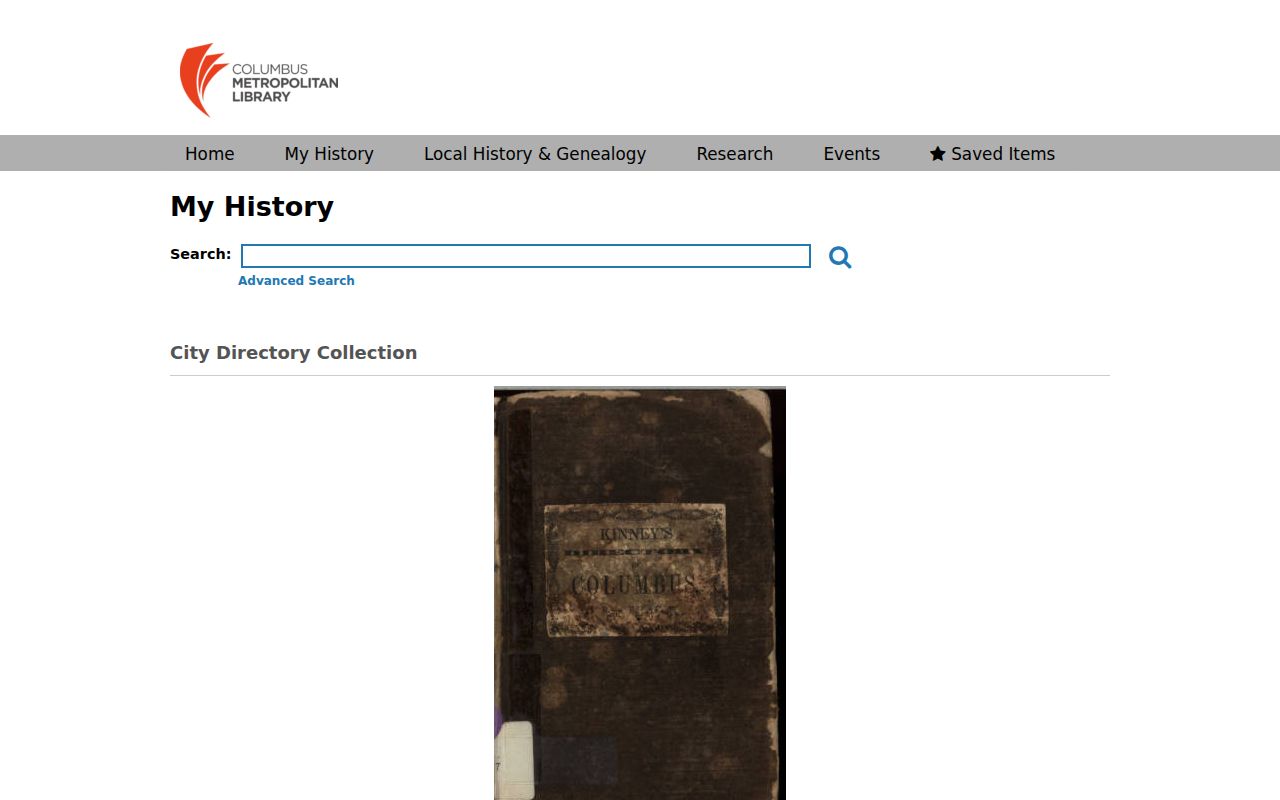
Because the captured collection page does not expose a complete item-and-year list, use an online discovery as a lead and confirm the edition or page in the library when a precise reading matters.
A 1915 transcription on the NEGenWeb Platte County pages is available online. It is valuable for locating a surname, yet it does not replace an original page image or resolve every abbreviated character. A quick comparison at the Heritage Room protects the wording that may later connect to a map, census line, or newspaper search.
Columbus Directory Dates Alongside Local Formats
Columbus records change format as the local sources change. Keeping the format with the date prevents a researcher from treating a newspaper notice, a phone listing, and a historical volume as if they carried the same scope.
| 1915 | Verified Heritage Room city-directory shelf starting point and the year of the available Columbus transcription. |
|---|---|
| January 1940 | Columbus telephone subscribers appear in digitized white pages, an alphabetical list rather than a full population roll. |
| 1874 / 1892 | The Columbus Democrat began as the Columbus Era in 1874 and became the Columbus Telegram in 1892, a useful title switch for newspaper searching. |
| June 2001 | Heritage Room Telegram microfilm runs through June 2001; CD access follows that point. |
The library’s U.S. Census microfilm covers 1860 through 1930. It helps bridge years between locally held directories, but an enumeration district and address should be checked before connecting a census name to a particular street. The shelf also includes Kramer High yearbooks from 1925 through Columbus High in 1960, Lakeview from 1970 onward, and Scotus or St. Bon’s from 1950 onward. Those are companion identity clues, not substitutes for an address source.
Reading a 1915 Columbus City Directory Entry
The 1915 transcription shows why a short entry deserves slow reading. A sample for L. P. Carstenson identifies a name and initials, the honorific Dr., the profession of veterinarian, the spouse Grace V. in parentheses, an r residence marker, a west-of-city-limits location, and an independent telephone number. The line is a dated listing, not proof of a later household.
| Indexed name | Surname and initials identify the listed subscriber or person and can distinguish a namesake when paired with another clue. |
|---|---|
| Honorific or profession | A title or role may appear next to the name and can help separate people with similar initials. |
| Spouse notation | A parenthetical spouse name is a relationship clue, not an exhaustive household list. |
| Residence marker | In the inspected entry, r appears in context as a residence marker before the location. |
| Place and telephone | Street, locality, directional wording, and an independent phone can anchor follow-up searches. |
No formal local abbreviation key was located for that transcription. Preserve the printed wording and verify an uncertain abbreviation against the Heritage Room copy rather than expanding it by guesswork.
Columbus City Directory Terms Worth Recording
Directory vocabulary varies by volume. These terms explain how to approach a book without assigning a feature to Columbus that the inspected material did not show.
- Criss-cross section
- An address-ordered portion of a directory, when a particular volume includes one. Ask the library whether the requested edition has a street-order section.
- Householder index
- An index arranged around households or heads of household. It can aid a surname search, but it does not necessarily enumerate every person at an address.
- Abbreviation key
- A guide, often near the front of a volume, that explains its own shortened forms. Photograph or note it before interpreting entries.
A later telephone book may have a different editorial system from an earlier volume. In the January 1940 Columbus list, subscriber name, initials, occasional honorific or occupation, residence marker, street or rural route, and telephone number are the visible field types.
Trace a Household Through Columbus City Directories
A household trail works best as a sequence of dated observations. Start with the entry nearest the event or address already known, then move outward one available edition at a time. For a street-level record path after the historical years have been narrowed, the Columbus street directory explains the distinct address-focused route.
- Write down the exact directory year, page, spelling, address wording, telephone, and every spouse or profession clue.
- Check the next available Columbus volume before and after that year, noting a first appearance, last appearance, move, or changed telephone.
- Compare the date to the 1860-1930 census microfilm and use the appropriate enumeration-district material before matching an address.
- Test a 1940 subscriber hit against the directory trail, while allowing for initials, OCR errors, rural-route formatting, and people without telephones.
- Use the obituary index, cemetery books, marriage books, plats, and deeds as separate dated sources when the name leaves the directory.
A disappearance can mean a move, death, changed listing practice, or no telephone subscription. It is a prompt for another source, not a conclusion by itself.
Archives Behind Columbus City Directories
The library shelf is one layer of a larger Columbus paper trail. The History Nebraska county-government records guide leads to Platte County RG267, dated 1865-1985. Its finding aid describes 221 cubic feet in 80 boxes, plus 299 volumes and 523 volumes on 147 reels, with county-office subgroups that include assessor, election, clerk, Register of Deeds, and courts.
For earlier town history, Columbus RG302 covers town records from 1856-1885. It includes Town Company minutes, lot deeds, and stock transfers, with five items on one microfilm reel. Those records can place an early lot relationship before a household appears in the verified directory shelf.
The December 1914 Columbus Sanborn set has 11 sheets. It supplies building and block context, not a person-name roll, so pair it with an entry, newspaper notice, plat, or deed instead of reading it as evidence of residence.
Limits of a Columbus City Directory Search
A directory records what that edition chose to print. The 1940 white pages are telephone-subscriber material, and the Nebraska Access guidance cautions that not everyone had a phone; OCR can also distort names and initials. Business and municipal entries appear alongside personal names, so label each result by its source relationship.
For earlier Columbus research, town minutes, plats, newspapers, county records, and archive finding aids may be stronger starting points than a directory. For later research, date the source and confirm it through the appropriate custodian before relying on it.
When a family question predates the verified 1915 shelf, the local library and archives remain useful even without a city-directory volume. The Heritage Room has Platte marriage books from 1858 through 1973, while the FamilySearch catalog identifies Platte County marriages from 1858 through 1889 on film. Access to that film can vary. These are relationship and date clues, not a substitute for an address listing, so pair them with a plat, newspaper, census, or later directory where the evidence supports the connection.